When your BRSR filing has to survive third-party assurance, can a spreadsheet tell you exactly where each number came from and who changed it last? For a growing number of Indian listed companies, the honest answer is no, and that is precisely the gap we built Vayura AI to close.
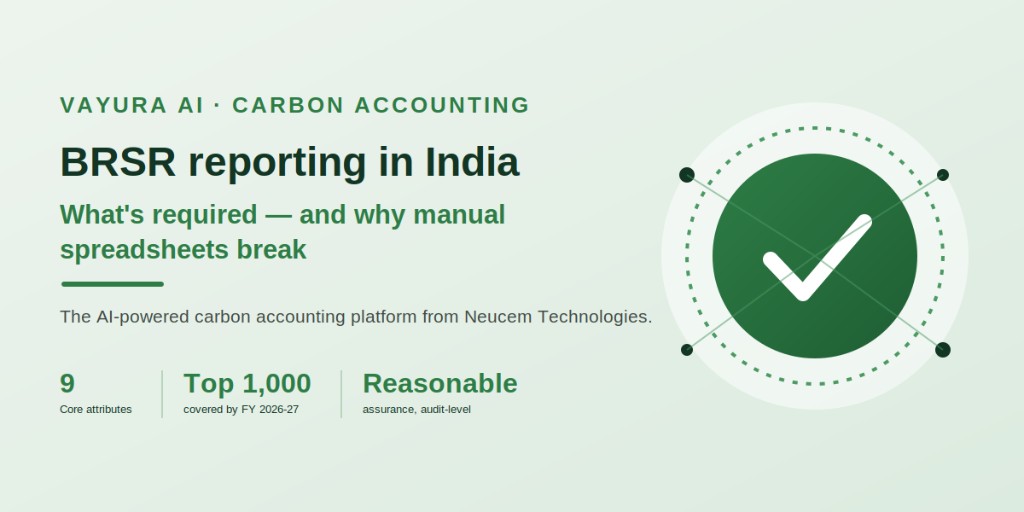
Business Responsibility and Sustainability Reporting is no longer a once-a-year disclosure exercise. It became mandatory from FY 2022-23 for the top 1,000 listed companies by market capitalisation, calculated as of 31 March each year. Because that ranking is recalculated annually, a single year's price movement can pull a company into scope — so Vayura AI is designed to onboard a new reporting entity in weeks, not the quarter a manual setup usually consumes.
What BRSR actually asks for
The framework is broad by design. Companies report against roughly 140 indicators, split into essential and leadership disclosures across nine principles drawn from India's National Guidelines on Responsible Business Conduct. Within that sits BRSR Core — a tighter set of 49 KPIs covering GHG emissions, renewable energy, water, waste and diversity.
Vayura AI maps directly to this structure, so each KPI has a defined owner, a source system, and a calculation method rather than living in an analyst's memory.
The stakes rise with assurance. External assurance of BRSR Core is phasing in by tier — top 150 from FY 2023-24, top 250 from FY 2024-25, top 500 from FY 2025-26, and the top 1,000 from FY 2026-27. More recently, SEBI's March 2025 circular added flexibility between assessment and assurance and reframed value-chain disclosure as comply-or-explain. Vayura AI tracks these tier-based obligations so teams near a threshold aren't caught unprepared when the rules tighten.
Why manual spreadsheets break under this load
Spreadsheets don't fail because people are careless. They fail because BRSR data is distributed. Emissions figures sit with facilities, workforce data with HR, governance details with the company secretary, and energy consumption in utility bills across dozens of sites. Consolidating that by hand means copy-paste, and every copy severs the link between the number and its source. Vayura AI keeps that link intact by pulling from source systems directly, so the value in the report traces back to the record that produced it.
Then there's the audit-trail problem. Assurance providers don't just want the number — they want evidence of how it was derived and confirmation that internal controls held. A spreadsheet has no reliable memory of who edited which cell, when, or why. Vayura AI logs every change with lineage and timestamps, which turns an assurance engagement from a document hunt into a query.
Version control compounds it. When five people email revisions of the same workbook before an AGM deadline, no one can be certain which file is authoritative. That uncertainty is where restatement risk lives — and where SEBI scrutiny bites. Vayura AI maintains a single source of truth, so there is one live dataset, not a dozen conflicting attachments.
How we approach it at Vayura AI
We treat BRSR as a data-engineering problem, not a paperwork one. Vayura AI collects ESG data continuously through the year rather than in an annual scramble, applies the calculation logic once, and holds the evidence in an assurance-ready form. Our teams handle the integration into your existing systems and stay close through your first assured cycle.
The outcome we aim for is simple: a filing you can defend line by line. With Vayura AI, the report is a by-product of well-governed data — not a fortnight of reconciliation before the deadline. As the top 1,000 move toward full assurance and value-chain reporting, that difference stops being a convenience and becomes the difference between a clean opinion and a qualified one. Learn more at neucem.com.