Measurement before claims — Vayura AI's no-greenwash rule for credible climate reporting.
A credible climate claim is not a communications decision — it is a data one. The reason most greenwashing happens is rarely deliberate deceit; it is a claim that ran ahead of the measurement behind it. That is the gap Vayura AI, the AI-powered carbon accounting platform from Neucem Technologies, is built to close. Its four capabilities — Unified Ingestion, a Governed Factor Library, AI Classification & Extraction, and Audit-Ready Lineage — exist to make one rule enforceable: no claim ships without a measurement behind it. This piece explains that rule, why estimates cannot carry a public claim, and why the regulatory direction is converging on exactly this discipline.
Greenwashing Is Usually a Data Problem, Not a Lie
The common thread running through recent greenwashing enforcement actions is not bad intent. It is claims that could not be substantiated with verifiable, current data when a regulator asked. A "climate neutral" label, a "40% greener" figure, an offset-based net-zero statement — each is defensible only if the number underneath it exists, is current, and can be traced.
Treating greenwashing as a moral failing misses the practical fix. Most organisations making shaky claims are not lying; they are working from data that was estimated, undocumented, or assembled once a year under deadline. The problem is upstream of the marketing team, in the measurement.
Our Rule: No Claim Ships Without a Measurement Behind It
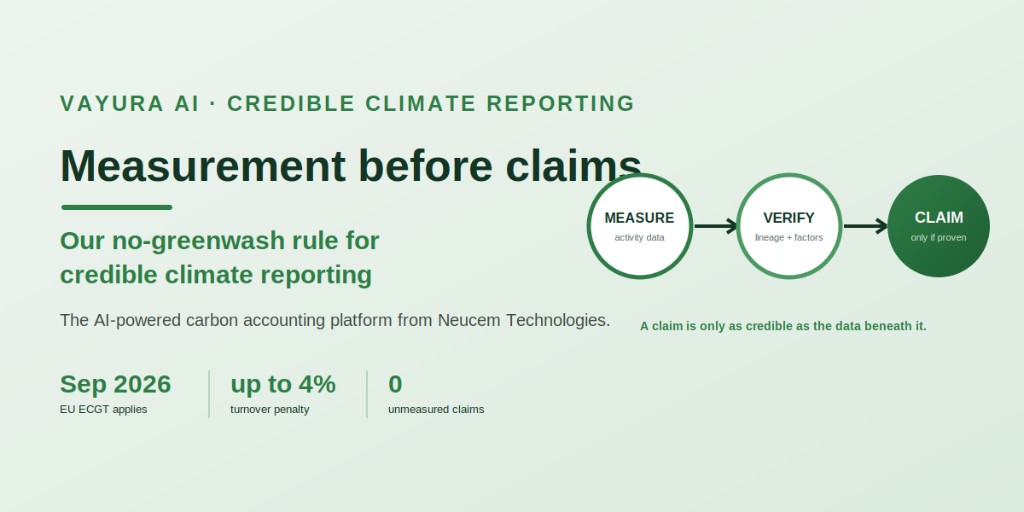
So the rule we build toward is deliberately blunt: a claim is only as credible as the data beneath it, and if the data is not measured, verified, and traceable, the claim does not ship.
That reframes climate reporting as an evidence discipline rather than a narrative one. Measure first. Verify the number against a governed factor and its source. Only then make the claim — and keep the lineage so it survives a challenge months later. It is the same standard finance applies to a revenue figure, and it is the standard regulators are moving toward for environmental figures.
Why Spend-Based Estimates Can't Carry a Public Claim
Most early carbon accounting leans on spend-based estimation — multiply money spent by an average emission factor. It is a legitimate way to get a first directional picture, and it is not a basis for a public claim.
The reason is that a spend-based number implies things that are not true: that buying more of the same material always raises emissions, and that a supplier who genuinely decarbonises changes nothing in your figures. Publish a reduction claim built on that method and it cannot withstand scrutiny, because it was never measuring the thing you claimed to improve. Moving from spend-based estimates to activity-based data — actual quantities, actual factors, supplier-specific where it matters — is what turns a number into something you can stand behind.
What Measurement-Grade Data Looks Like
Measurement-grade data has four properties, and Vayura AI is organised around producing them.
Unified Ingestion pulls activity data straight from the systems where it already lives — ERP records, utility and fuel invoices, fleet telematics, logistics manifests — rather than from a re-keyed spreadsheet. The Governed Factor Library applies one versioned, governed set of emission factors, so a claim never rests on two plants quietly using different numbers. AI Classification & Extraction does the repetitive work of sorting spend into the correct categories and reading values out of unstructured supplier documents. And Audit-Ready Lineage attaches a traceable path from every figure back to its source record — so when a regulator, assurer, or journalist asks "how do you know?", the answer is a document, not a shrug.
The Rules Are Converging on Substantiation
The regulatory direction is unambiguous, even where individual laws are still moving. The EU's Empowering Consumers for the Green Transition Directive (ECGT) applies from 27 September 2026 and bans generic environmental claims and offset-based "climate neutral" product labels unless they are substantiated — with penalties reaching up to 4% of annual turnover in the relevant member state.
The more prescriptive Green Claims Directive that would have sat alongside it is, by contrast, paused — its trilogue was cancelled in 2025 and its status remains uncertain. But that has not softened the environment, because enforcement already happens under existing consumer-protection law regardless of whether dedicated greenwashing legislation passes. For Indian companies the pressure is domestic as well: SEBI's BRSR Core requires assessment or assurance of ESG data reaching the top 1,000 listed entities from FY 2026-27, and the EU's CBAM, in its definitive phase since 1 January 2026, penalises exporters whose emissions data is not verified. Every one of these rewards the same thing — a claim with measurement behind it.
Measurement Before Claims, in Practice
In practice the rule changes the order of operations. Instead of deciding the message and then hunting for numbers to support it, you establish the measured, traceable number first and let it determine what you can honestly say.
That is less exciting than a bold headline, and it is the difference between a claim that builds trust and one that becomes a liability the moment someone checks. Vayura AI exists to make the honest path the easy one — so the credible claim is also the convenient one.
The Numbers at a Glance
Why measurement now decides what you can credibly claim:
- EU ECGT applies from 27 September 2026 — bans generic and offset-based "climate neutral" claims unless substantiated
- 27 March 2026 — ECGT member-state transposition deadline
- up to 4% of annual turnover — penalties for breaches (per member state)
- Green Claims Directive is paused (trilogue cancelled, 2025) — but enforcement continues under existing consumer-protection law
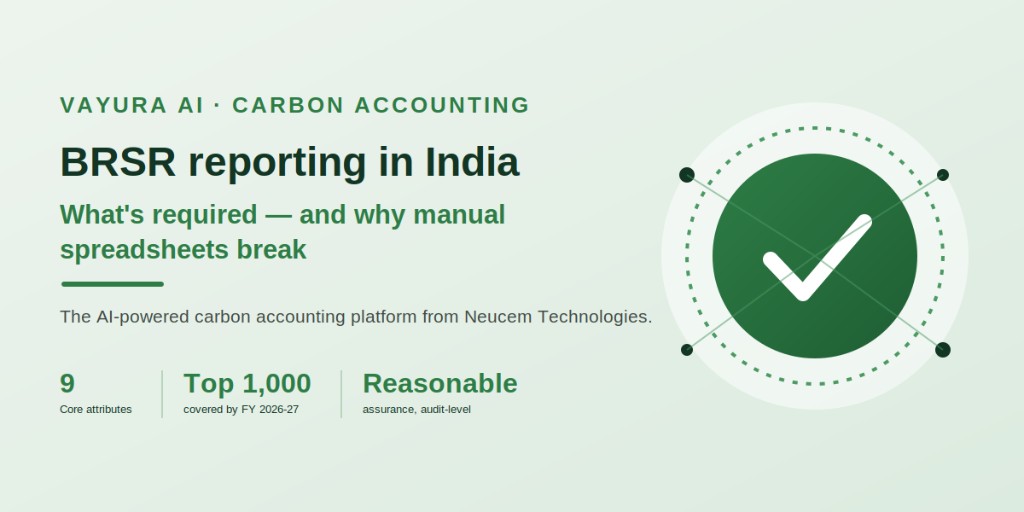
- Top 1,000 listed entities reached by BRSR Core assessment-or-assurance from FY 2026-27 (India)
- CBAM definitive phase since 1 January 2026 penalises unverified exporter emissions
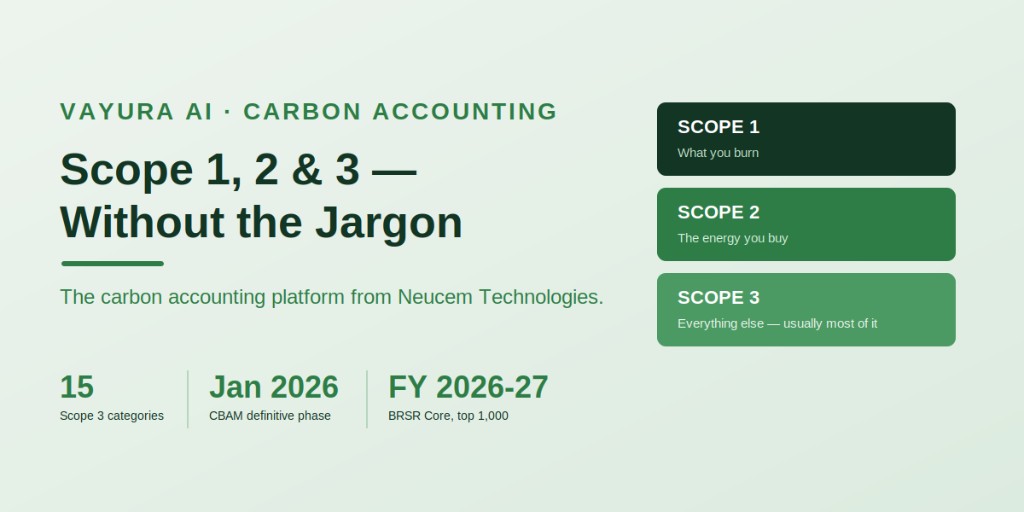
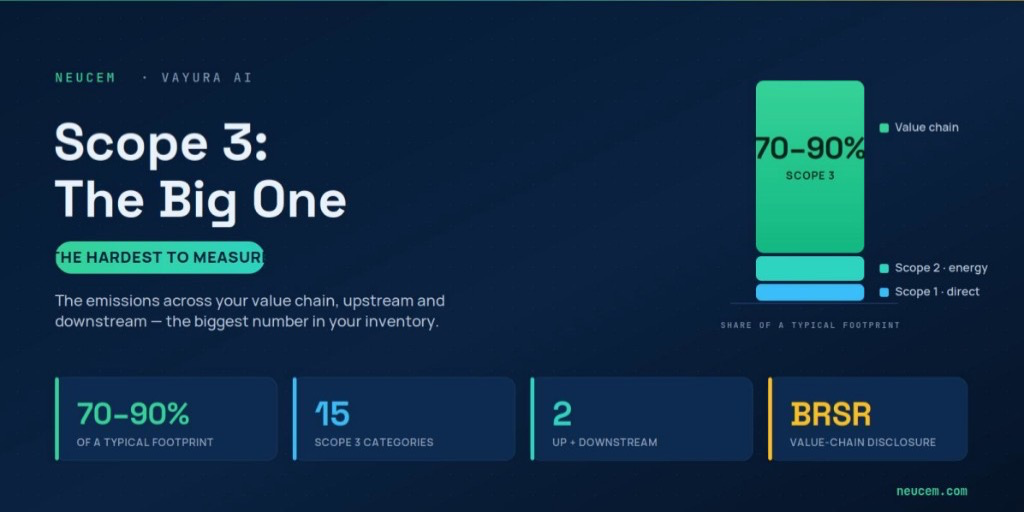
- 15 Scope 3 categories (GHG Protocol) — usually the majority of a footprint, and the hardest to substantiate
Vayura AI is the AI-powered carbon accounting platform from Neucem Technologies — bringing Unified Ingestion, a Governed Factor Library, AI Classification & Extraction, and Audit-Ready Lineage into one place so that every climate claim rests on measured, traceable data. We work talent-first, with clean architecture and honest estimates: engagements typically begin with a data and readiness assessment of what you measure, what you estimate, and which claims you need to defend. Whether you need a single specialist or a full delivery team, we scale to fit. To put measurement before claims in your own reporting, request an assessment at neucem.com.