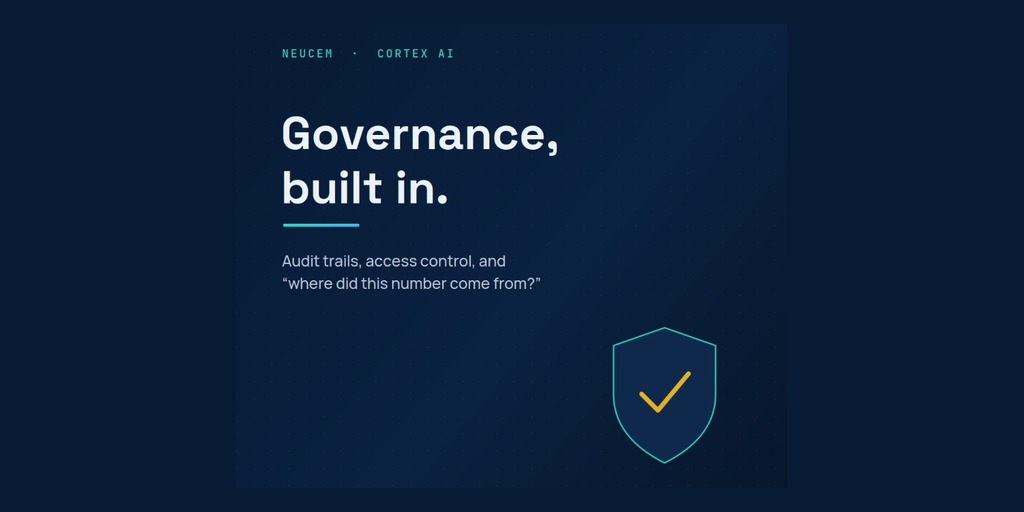
When Cortex AI hands your team a number — a churn forecast, a capacity threshold, a flagged anomaly — can you explain exactly where it came from?
For the CIOs, CTOs, and network leaders we work with across India, that question has stopped being academic. As AI moves out of experiments and into decisions that touch customers, revenue, and uptime, "the model said so" is no longer an acceptable answer — not to an auditor, not to a regulator, and not to your own incident review. Governance is what turns an AI output from a black box into something your organization can stand behind.
We built Cortex AI on a simple principle: governance is not a feature you add later. It is the substrate everything else runs on. Here is what that means in practice.
The problem with governance bolted on afterwards
Most AI deployments treat governance as a wrapper — a logging library here, a permissions check there, added once the model is already in production. The gaps then surface at the worst possible moment. A customer disputes a figure produced by an AI-assisted process. A regulator asks how personal data entered a pipeline. A NOC engineer needs to know whether last night's automated remediation fired on real telemetry or a corrupted feed. When the answers live in scattered logs or nowhere at all, you end up reconstructing the truth under pressure, if you can reconstruct it at all.
Built-in governance removes that scramble. Three capabilities carry most of the weight.
1. Audit trails that reconstruct any decision
Every interaction with Cortex AI is recorded as an immutable event: who or what asked, which data was accessed, which model and version responded, and what came back. Because the trail is captured at the platform layer rather than sprinkled through application code, it is complete by default. When someone needs to understand a decision weeks later, you replay it from the record instead of reasoning from memory. For regulated workloads, that difference is the line between a routine audit and an open-ended investigation.
2. Access control that enforces least privilege
Governance fails quietly when everyone can see everything. Cortex AI applies role- and attribute-based access so that identity, purpose, and context determine what data a request can reach, not just whether a user is logged in. Data residency and consent scope are honoured as part of the same check, so a model serving one business unit cannot quietly pull data it was never entitled to. The principle is straightforward: the right people and processes see the right data, and nothing more.
3. Lineage — answering "where did this number come from?"
This is the capability leaders ask for by name. For any output, Cortex AI can trace the full path backward: from the number, to the context and prompt that shaped it, through the transformations applied, to the source records underneath. Provenance is attached to the result rather than reconstructed after the fact. So when finance questions a projection or a regulator asks you to substantiate a figure, the answer takes minutes to produce, with the evidence intact, not weeks of manual archaeology across systems.
Why this matters more in India, and more every quarter
Under the DPDP framework, and alongside the sectoral obligations that telecom, BFSI, and enterprise operators already carry, the ability to demonstrate how data was used is becoming a baseline expectation rather than a differentiator. Retrofitting that capability after a compliance question lands is expensive and rarely convincing. Building it in means residency, consent, and audit requirements are enforced continuously, as a property of the platform, not a project you launch once the pressure is on.
Where Neucem fits
We designed Cortex AI so that the governed path is the default path — the easy way to build is also the accountable one. And we bring engineers who understand both the AI and the operational and regulatory environment it runs in, so governance reflects how your business actually works rather than a generic checklist.
If your AI is starting to inform decisions you will one day have to defend, the time to build in governance is before that day, not after it. Learn more about Cortex AI and our AI services at neucem.com.