How many separate tools does your team touch to turn raw telemetry into a decision — and how many of them actually talk to each other? That single question is why we built Cortex AI, and it's the one we ask every infrastructure leader we meet.
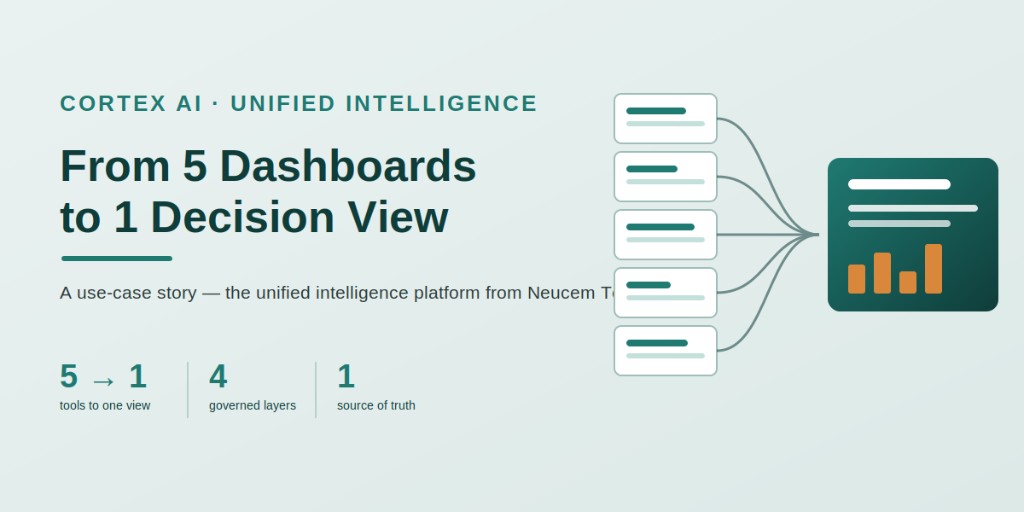
Most enterprise data and AI stacks were never designed. They accumulated. A team adopts one tool for ingestion, another for the warehouse, a third for transformation, a fourth to train and serve models, and a fifth for orchestration. Each was sensible at the time. Cortex AI exists because that accumulation, taken together, becomes a stack that is expensive in ways no single invoice reveals.
The tax you don't see on the bill
Licensing is the visible cost. The hidden cost is the integration tax — the engineering hours spent moving data between systems, reconciling schemas, and debugging pipelines that break the moment one vendor changes an API. Cortex AI removes that tax at the source by keeping ingestion, transformation, and modeling on one foundation instead of five.
Consider a common scenario. A NOC team wants to detect anomalies across a large access network before users feel the degradation. The live telemetry sits in one system, the historical baseline in a warehouse, the model on a separate ML platform, and the alerting logic somewhere else again. Every handoff adds latency and another copy of the data. Cortex AI collapses those handoffs so the model reads the telemetry directly, rather than a stale copy of it.
The result of fragmentation is measurable: slower time-to-insight, models trained on data that is already hours old, and engineers maintaining plumbing instead of improving detection. Because Cortex AI holds the data and the model in the same governed environment, that lag largely disappears — detection moves closer to real time.
Fragmentation is a governance and security problem, too
Every tool in the chain is an access boundary, a credential to rotate, and an audit log to reconcile. When data is copied across five environments, governance becomes guesswork. Cortex AI applies policy once, at the platform level, so for CIOs and CTOs accountable under India's evolving data protection requirements, a smaller attack surface and a faster audit follow directly from the architecture rather than from added controls.
Why consolidation changes the operating model
The advantage of Cortex AI is not novelty; it is fewer moving parts. When the data and the model live in one place, you eliminate the copies, the connectors, and the lag between them. An anomaly-detection model running on Cortex AI sits close to the telemetry it depends on, so detection happens before the incident surfaces, not after.
For the teams we support, Cortex AI changes the operating model. Engineers stop maintaining pipelines and start solving problems. Onboarding a new use case takes days instead of a quarter, because standing up a model on Cortex AI no longer means provisioning an entirely new stack.
How Neucem approaches it
We don't treat Cortex AI as a rip-and-replace. Our teams assess your existing environment, identify where fragmentation is costing you the most, and migrate to Cortex AI in stages — usually starting with the highest-friction workflow. We bring the engineering talent to run the migration and the operational discipline to keep your network running throughout.
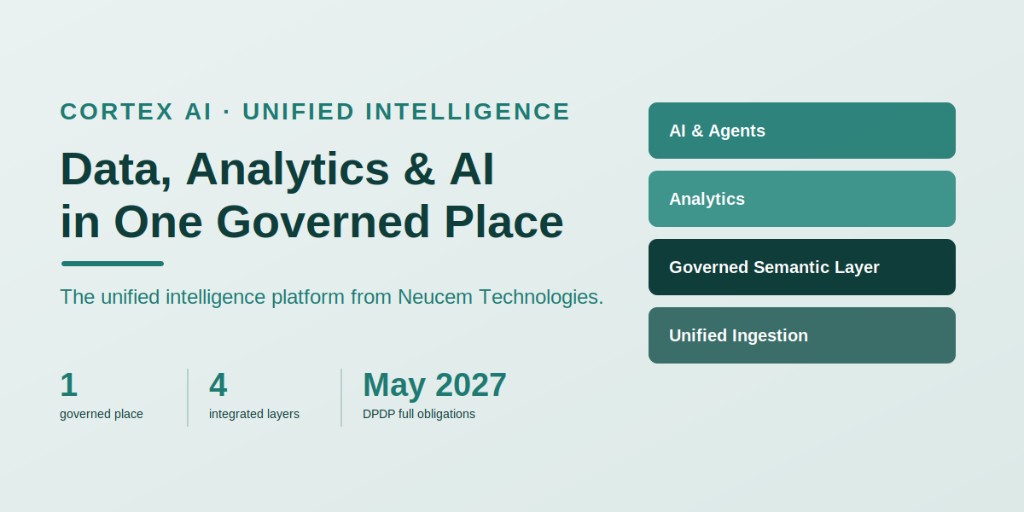
The goal is straightforward: a stack you can reason about. Cortex AI gives you one platform where data and AI are governed together, where insight arrives before the incident does, and where your team's time goes to engineering outcomes rather than integration overhead.
If your team is running five tools where one platform would do, the hidden cost is already on your books — spread across a dozen line items and a lot of engineering hours. Cortex AI is how we help you consolidate it. Learn more at neucem.com.