Why do so many corporate climate programmes stall — not on the science of cutting emissions, but on the far more mundane task of simply measuring them?
For the sustainability, finance, and operations leaders we work with across India, the honest answer is uncomfortable. The ambition is there. The targets are set. What's missing is a trustworthy number to act on — and the reason is almost never atmospheric science. It's data. Before climate intelligence is a climate problem, it is a data problem.
Getting that order right changes how you solve it.
The number is only as good as the data beneath it
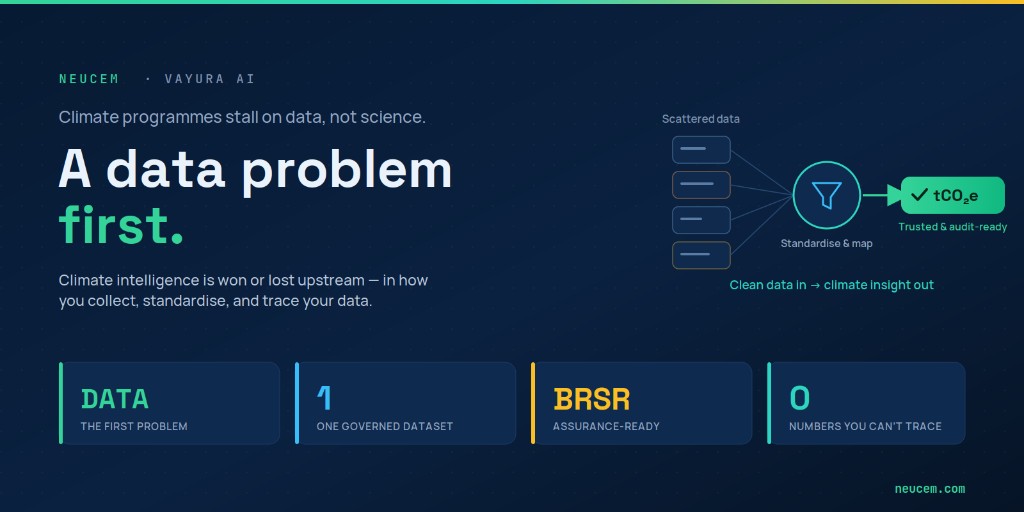
A carbon footprint isn't read off a sensor. It is assembled — from utility bills, ERP records, procurement spend, fuel logs, logistics manifests, travel systems, and supplier disclosures, each in its own format, unit, and system of record. Turning that sprawl into a single defensible emissions figure is a data-engineering task long before it is a sustainability one. If the inputs are incomplete, inconsistent, or unverifiable, no amount of climate expertise downstream can rescue the result.
Where the data problem actually lives
Four issues recur in almost every organisation.
First, the data is scattered across systems that were never designed to talk to each other — finance, operations, facilities, and dozens of suppliers. Second, it is inconsistent: different units, currencies, granularities, and naming, so before anything can be summed it has to be standardised. Third, it has to be mapped to emission factors correctly — the same line of spend can imply very different emissions depending on the factor applied, and that mapping is where most errors hide. Fourth, much of it is simply missing, so gaps must be estimated defensibly rather than ignored or guessed.
None of these are climate questions. They are data questions — collection, standardisation, mapping, and quality — and they decide whether the climate number that finally emerges means anything at all.
Why this is the part that actually matters
Two consequences follow directly. You cannot reduce what you cannot measure: without an accurate baseline, you can't tell whether a decarbonisation initiative worked or just shifted the estimate. And you cannot claim what you cannot trace: under SEBI's BRSR framework, and increasingly for investors and large customers, disclosures need provenance and assurance. A number with no data trail behind it isn't a disclosure — it's a liability.
A familiar scenario
A company sets out to report Scope 3 from purchased goods. The spend data lives in the ERP; the supplier list is a spreadsheet; emission factors sit in a reference table someone maintains by hand; and half the suppliers haven't provided primary data. The team spends weeks reconciling all of it before a single figure can be reported — and when an assurer asks how a number was derived, the trail runs cold. The bottleneck was never climate knowledge. It was data infrastructure.
How Vayura AI treats climate as a data problem first
We built Vayura AI as a climate data platform, not a reporting form. It ingests data from across your systems and suppliers, standardises it into a consistent model, and maps it to the right emission factors — using AI to fill gaps defensibly where primary data is missing, then upgrading those estimates as real data arrives. Crucially, every figure carries its lineage, so what you disclose is traceable to source and ready for BRSR assurance from the start. Solve the data problem well, and the climate intelligence — baselines, hotspots, reduction tracking — follows almost for free.
Where Neucem fits
This is precisely the intersection we work at: rigorous data engineering in service of a climate outcome. With Vayura AI and the engineers behind it, we turn scattered, inconsistent climate data into a governed foundation you can measure, improve, and defend.
If your climate programme feels stuck, the problem is probably upstream of the climate. Learn more about Vayura AI and our AI services at neucem.com.