The board has stopped accepting activity as evidence. "Seats licensed," "hours saved," and "productivity up" no longer survive the one question a CFO actually asks: what did we get for the money, on the P&L, against a baseline? Producing a number that survives that question is an engineering and measurement discipline, not a slide — and it is what Neucem AI Services is built to deliver. Through our Talent & Staff Augmentation, Dedicated AI/ML Teams, Full-Stack & Cloud Engineering, Custom Software & Product Engineering, and Managed Remote / Outsourced Teams, we build AI systems that are measurable from day one. This piece sets out what "defensible" means in 2026, why most AI ROI collapses under a board question, and how to build the measurement before you build the model.
The Board Stopped Accepting Activity as Evidence
For two years, AI business cases leaned on adoption and productivity metrics because vendors made those easy to track. That era is over. In 2026, finance leaders have grown openly sceptical of productivity claims that never reach the operating statement — a presentation showing employees save four hours a week is a description of activity, not a business case.
The market data has shifted with them. Direct financial impact — revenue growth and profitability combined — has overtaken productivity as the ROI metric boards and investors treat as credible. The question is no longer "are people using it?" but "what line of the P&L moved, and can you prove the AI moved it?"
What "Defensible" Actually Means
A defensible AI return has four properties, and missing any one of them is what makes a number fall apart in the boardroom.
It has a pre-deployment baseline — you measured the before, so the after means something. It has a named P&L owner — a business executive, not the AI team, accountable for the outcome. It is expressed as a specific financial outcome tied to that baseline, not a self-reported percentage. And it carries kill criteria — a pre-agreed threshold below which the initiative stops. Deloitte's 2026 research found that the roughly one-third of enterprises generating strong AI returns are distinguished not by better tools but by exactly this: they treat AI as a portfolio of capital investments with baselines, owners, and kill criteria. That is an organisational-design decision, and it is where our Custom Software & Product Engineering engagements begin — with the outcome and its measurement defined before any build.
Why Most AI ROI Can't Survive a Board Question
The failure is structural, not technological. Organisations deploy AI without establishing the baseline, without naming the owner, and without agreeing what success is in financial terms — so when the CFO asks "what did we get?", the room goes quiet.
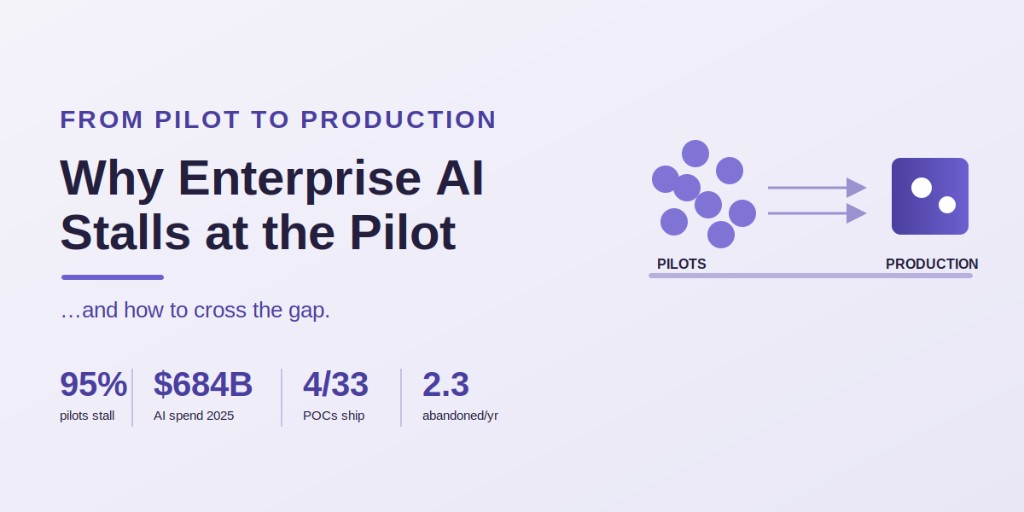
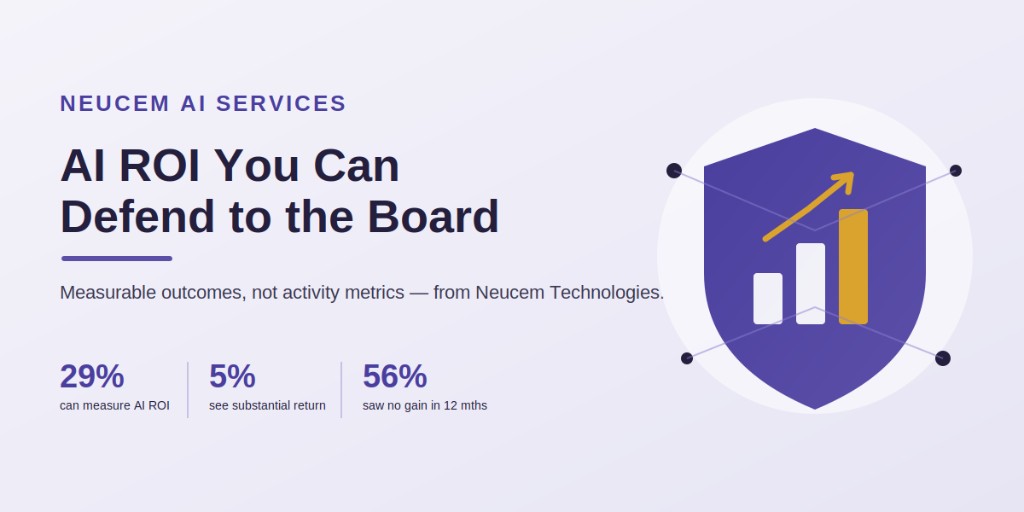
The numbers make the gap concrete. Only around 29% of executives say they can confidently measure AI ROI, even as the large majority report perceiving productivity gains — a striking distance between belief and proof. It is the same pattern we described in our work on pilots that stall before production: the model works, the demo impresses, and then no one can defend the value. Our Dedicated AI/ML Teams close that gap by instrumenting the outcome — logging the baseline and the post-deployment result as part of the system, not as an afterthought.
Cost Per Outcome: The Number That Travels
If you adopt one metric this year, make it cost per outcome — the fully-loaded cost of producing one unit of business result, before and after AI.
It travels because it survives translation. A team that handles 40% more tickets after deployment without adding headcount has produced a lower cost per ticket, which is a measurable financial return regardless of what happened to absolute spend. Cost per outcome converts an AI system's effect into a single number a finance team will accept and a board will remember — and building the data pipeline that computes it honestly, from real operational records, is the province of our Full-Stack & Cloud Engineering work.
Build the Measurement Before You Build the Model
The order matters. Most programmes build the model first and try to reverse-engineer the ROI later, which is precisely why the baseline is missing when it is needed. The discipline is to define one measurable outcome, establish its baseline, model the fully-loaded cost, and only then build — so the proof accrues automatically as the system runs.
This is deliberately unglamorous, and it is the difference between an AI initiative that renews and one that gets quietly cancelled. Where the constraint is people to do this rigorously, our Talent & Staff Augmentation places the data and ML specialists who can; where it is sustained ownership of the measurement after launch, our Managed Remote / Outsourced Teams hold it.
Where Neucem AI Services Fits
We are a delivery partner, and we will say the unglamorous part plainly: if you cannot name the outcome, the baseline, and the owner, the honest first step is not to build — it is to define those, and we would rather help you do that than ship a system whose value you cannot defend.
Where we add value is turning a defined outcome into an instrumented, measurable system: Custom Software & Product Engineering to build it, Full-Stack & Cloud Engineering to compute the numbers from real data, Dedicated AI/ML Teams to own the model, Talent & Staff Augmentation when the gap is people, and Managed Remote / Outsourced Teams for the measurement's life after launch. We scale from a single specialist to a full delivery pod, and we transfer the measurement discipline as we go.
The Numbers at a Glance
Why AI ROI is the defining finance question of 2026:
- ~29% of executives can confidently measure AI ROI (IBM; echoed by McKinsey's 2026 survey)
- ~5% of organisations achieve substantial, bottom-line AI ROI; ~35% report partial returns (IBM, 2026)
- 56% of CEOs saw neither revenue growth nor cost reduction from AI in the prior 12 months; only 12% achieved both (PwC 2026 CEO Survey)
- ~28% of AI use cases fully meet their ROI expectations (Gartner)
- ~34% of enterprises seeing strong returns treat AI as a governed portfolio with baselines, owners, and kill criteria (Deloitte, 2026)
- Direct financial impact (21.7%) has overtaken productivity gains (18%) as the primary, board-credible ROI metric (Futurum, 1H 2026)
- ~95% of enterprise GenAI pilots showed no measurable P&L impact (MIT Project NANDA, preliminary)
Neucem AI Services helps enterprises build AI that is measurable from day one, through five engagement models: Talent & Staff Augmentation, Dedicated AI/ML Teams, Full-Stack & Cloud Engineering, Custom Software & Product Engineering, and Managed Remote / Outsourced Teams. We work talent-first, with clean architecture and honest estimates — including telling you when the right first step is to define the outcome, not build. Whether you need a single specialist or a full dedicated team, we scale to fit and transfer the measurement discipline as we go. To build an AI business case that survives the board, request a review at neucem.com.