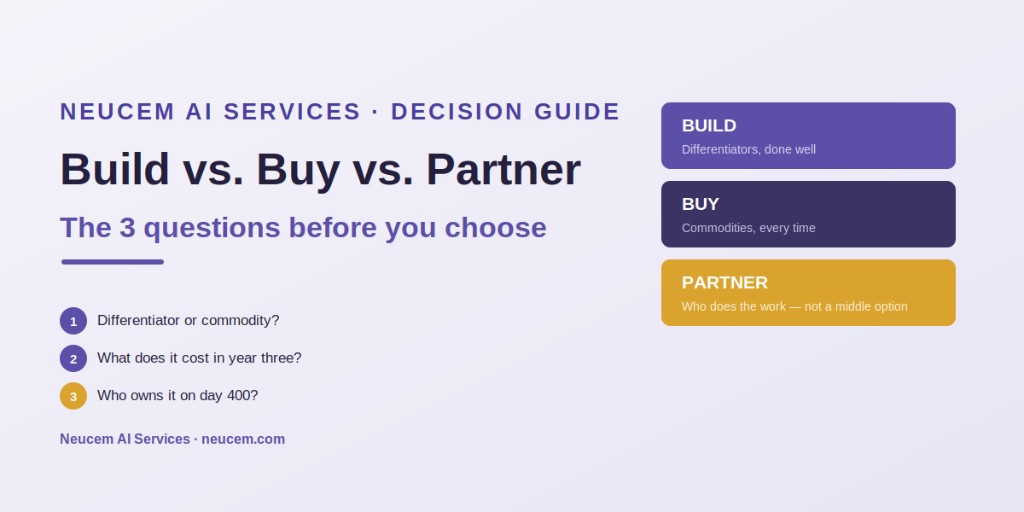
Most build-vs-buy decisions are settled on first-year cost, when what is actually being decided is a hiring plan, an operating model, and a maintenance commitment that outlasts the people who signed off on it. Neucem AI Services exists on one side of that decision — through our Dedicated AI/ML Teams, Full-Stack & Cloud Engineering, Custom Software & Product Engineering, Talent & Staff Augmentation, and Managed Remote / Outsourced Teams, we are the build-and-partner answer, not the buy answer. Which is exactly why the three questions below matter before you engage anyone, us included. Answer them on paper first, and the right path usually names itself.
Question 1: Is This a Differentiator, or a Commodity?
The test is simple. Does this capability appear anywhere in the reason a customer chooses you over a competitor? If a prospect would never know it existed, it is infrastructure. If it is part of what you sell, it is product.
Commodity capabilities — identity management, payment processing, ticketing, standard observability — have mature vendors, competitive pricing, and no strategic upside to building your own. The market has already absorbed the R&D cost; building here means paying twice for a worse result. Differentiating capabilities are the reverse: if your pricing engine, matching logic, or clinical workflow is how you win, buying a generic version hands your edge to a vendor who sells the same thing to everyone in your sector.
Most disappointments come from getting this backwards — building the commodity because it felt interesting, buying the differentiator because a demo was convincing. When something is genuinely differentiating, our Dedicated AI/ML Teams and Custom Software & Product Engineering are built to take it to production properly.
Question 2: What Does This Cost in Year Three?
First-year comparisons flatter building and penalise buying. Licence fees are visible and invoiced; engineering time is already on the payroll and feels free. Year three tells the truth.
Building carries a maintenance tail most business cases omit. The first release is a fraction of the lifetime cost — what follows is dependency upgrades, security patching, framework migrations, on-call, and the documentation nobody wrote. The software-engineering consensus is stark: the IEEE Computer Society puts maintenance at 60–80% of total software lifecycle cost, Gartner reports organisations spend 55–80% of IT budgets just maintaining existing systems, and over a full lifecycle, maintenance typically totals two to four times the original build investment. Unlike a licence, that spend is invisible until something breaks.
Buying has its own tail — integration work, customisation that drifts from the vendor's upgrade path, per-seat costs that scale with your success, and exit cost if the vendor changes direction. Partnering sits between the two, and its real cost is knowledge transfer: rate cards are easy to compare, but whether capability stays with you when the engagement ends is what separates a good outcome from a bad one. That is why our Managed Remote / Outsourced Teams are structured around transfer, not dependency.
Question 3: Who Owns This on Day 400?
Not day one — day one is always covered by the project plan. Day 400 is when the original team has rotated, the person who understood the queueing logic has moved on, and someone must answer a production page at 3 a.m.
This question carries particular weight in India right now. The country hosts well over 2,000 global capability centres employing roughly two million professionals, and these GCCs commonly pay 12–20% salary premiums over traditional IT-services firms, with senior engineering roles taking three to six months to fill. A build decision is therefore a hiring decision — and a retention commitment for the life of the system. If you cannot name the team, the runbook, and the on-call rotation eighteen months out, you have not made a decision; you have deferred one. Filling that ownership is precisely what Talent & Staff Augmentation and an embedded Dedicated AI/ML Team are for.
Partner Is Not the Middle Option
This is the most common framing error. Build, buy, and partner are not three points on one scale.
Build and buy answer what you get. Partner answers who does the work. You can partner to build a differentiating system; you can partner to integrate something you bought. The two decisions are separate, and collapsing them into a single spectrum is how organisations end up with a compromise that satisfies nobody. When the "who does the work" answer is a partner, our Full-Stack & Cloud Engineering covers the integration surface and our Custom Software & Product Engineering covers the build itself.
Where Neucem AI Services Fits — and Where It Doesn't
We are a delivery partner, so we have an obvious commercial interest in the answer. We will say this plainly: on commodity capabilities, we will usually tell you to buy — and we would rather say that in the first conversation than eighteen months into a build.
Where we add value is the other two cases: differentiating systems that should be built well, and bought systems that need serious integration engineering. Which service fits depends on where you are — Talent & Staff Augmentation when the gap is people, a Dedicated AI/ML Team or Custom Software & Product Engineering when it is the build, Full-Stack & Cloud Engineering when it is integration, and Managed Remote / Outsourced Teams when it is ongoing ownership after launch. We scale to fit, from a single specialist to a full delivery pod, and structure engagements so documentation and runbooks transfer as the work proceeds rather than in a handover week at the end.
The Numbers at a Glance
Why the build-vs-buy-vs-partner choice is a lifecycle decision, not a first-year one:
- 60–80% of total software lifecycle cost is maintenance, not the initial build (IEEE Computer Society)
- 55–80% of IT budgets go to maintaining existing systems (Gartner)
- 2–4× the original development investment is what maintenance typically totals over a full lifecycle
- ~2× the failure rate of vendor-led solutions is what internal AI builds have shown (MIT Project NANDA, preliminary)
- 2,000+ global capability centres now operate in India, employing ~2 million professionals
- 12–20% salary premiums are common at GCCs over traditional IT-services firms
- 3–6 months to fill senior engineering roles — a build is a retention commitment, not a one-time hire
Neucem AI Services helps enterprises on the build-and-partner side of this decision through five engagement models: Talent & Staff Augmentation, Dedicated AI/ML Teams, Full-Stack & Cloud Engineering, Custom Software & Product Engineering, and Managed Remote / Outsourced Teams. We work talent-first, with clean architecture and honest estimates — including telling you to buy when buying is right. Whether you need a single specialist or a full dedicated team, we scale up or down to fit, and transfer capability as we go. To pressure-test a build-vs-buy-vs-partner decision, request a review at neucem.com.