What if the reason your AI pilot stalled has nothing to do with the model you chose?
For most of the organizations we work with across India in telecom, ISP operations, managed services, and large enterprise IT, the bottleneck is rarely the algorithm. It is the data feeding it. A model is only as good as the signal it learns from, and in most environments that signal is scattered across silos, inconsistently labelled, and governed by rules no one has fully mapped. The outcome is predictable: promising proofs-of-concept that never survive contact with production.
This is a solvable problem. Below is the 90-day path we use at Neucem to move a data estate from "not ready" to genuinely model-ready — treated as an engineering program, not a science experiment.
Why AI projects stall at the data layer
Consider a familiar scenario. A network operations team wants an AIOps model to predict congestion and pre-empt outages. The telemetry already exists — flow records, syslogs, SNMP counters, ticket histories — but it lives in six systems with mismatched timestamps, duplicate device identities, and gaps during exactly the incidents you most want to learn from. Train on that, and the model learns the noise, not the network.
The pattern repeats regardless of use case. The failure sits upstream of the model: incomplete records, undocumented lineage, no single definition of a "customer" or a "site," and access rules that surface only when the compliance team asks how personal data ended up in a training set. None of this is exotic. It is simply unaddressed because data readiness is unglamorous work that rarely gets funded until a pilot fails.
The 90-day fix
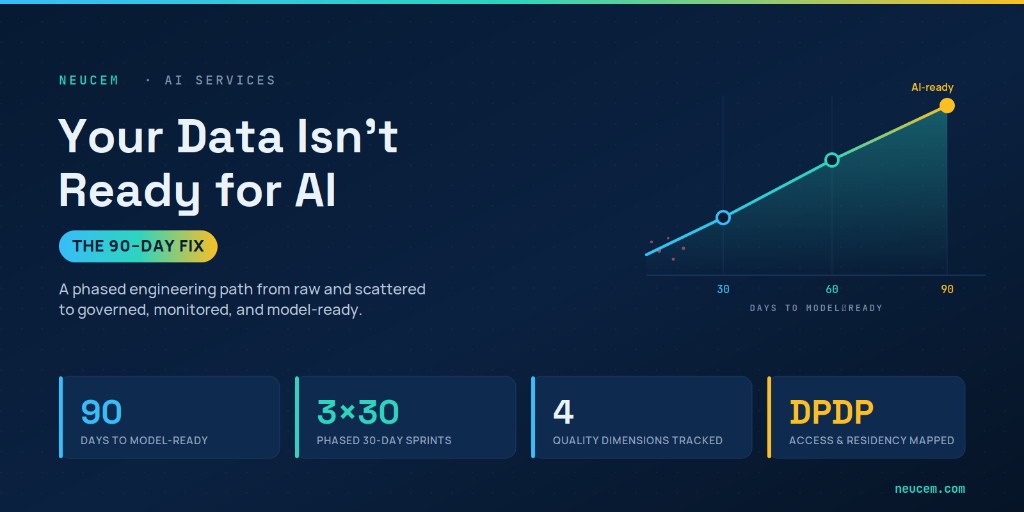
We structure readiness as three 30-day phases, each with a defined exit state so progress is visible and measurable.
Days 1–30: Assess and baseline
We inventory every source, schema, and lineage path, then measure the data honestly: completeness, accuracy, duplication, and drift. In parallel, we map access, consent, and residency constraints — a first-class concern under India's DPDP framework. The output is a clear-eyed readiness baseline, not a guess.
Days 31–60: Engineer and govern
With the baseline in hand, we clean, de-duplicate, and standardize data into governed pipelines. We label and structure it specifically for the target use case, and put ownership, versioning, and audit trails in place so quality holds after we leave. This is where a pile of data becomes a maintained asset.
Days 61–90: Operationalize and validate
We stand up the serving layer — feature stores, vector stores, and retrieval where relevant — and wire monitoring for quality, drift, and model feedback. Then we validate against a real pilot, so readiness is proven by a working result rather than asserted on a slide.
What "ready" actually looks like
Ready does not mean perfect. It means measurable and maintained. When a data foundation is ready, your team can answer three questions without hesitation: Where did this data come from? Is its quality good enough for this decision, and how do we know? And will it stay that way as volumes grow and schemas change? Get those three right, and model selection becomes the straightforward part — as it should be.
Crucially, this foundation compounds. The pipelines, governance, and monitoring you build for the first use case make the second and third dramatically cheaper. The 90 days is an investment in every AI initiative that follows, not a cost carried by one.
Where Neucem fits
We bring engineers who have done this at scale — people fluent in data platforms, pipelines, and the operational realities of running them in production. We can embed a single specialist alongside your team or stand up a full pod, then scale up or down as the work demands. Throughout, we hold to honest estimates and dependable delivery: you will always know what is ready, what is not, and what it will take to close the gap.
If your AI ambitions are outrunning your data, that is not a reason to wait — it is the exact problem the next 90 days can fix. Learn more about our AI services at neucem.com.